


 Find additional Shakespeareances
Origin Story of Shakespeare's Leading Ladies
Hamnet: A Novel of the Plague
Maggie O'Farrell (Alfred A. Knopf, 2020)
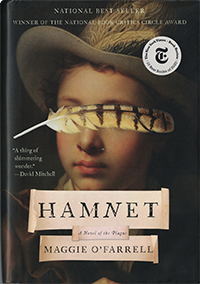 The fictional Hamnet’s story starts as an 11-year-old boy in Warwickshire looking for someone to help his ailing twin sister. The only family member he encounters is his drunk grandfather, a glovemaker, who instead of helping his grandson, strikes him.
The factual William Shakespeare’s story effectively starts with a drunk tinker in Warwickshire who is tricked into thinking he is a landed lord. Through the theatrical device of a play within a play, the tinker’s story gives way to a brawling love story played out by a troupe of traveling players, a play about a woman labeled a "shrew" who is actually a sharply intelligent elder sister and inspires the man who “tames” her.
This is one of many oblique references to Shakespeare’s canon in Maggie O’Farrell’s intelligently addictive novel Hamnet. With the subtitle “A Novel of the Plague,” Hamnet uses historical figures in imagining the death of Shakespeare’s only son and how it may have impacted the playwright's composing Hamlet, what is almost universally considered the greatest achievement in literary history. A note at the front of O’Farrell’s book quote’s historian Steven Greenblatt’s observation that Hamnet and Hamlet were interchangeable names in Shakespeare’s time. One example: a Stratford-upon-Avon neighbor mentioned in Shakespeare’s will, whom the real Hamnet was probably named after.
O’Farrell uses historical figures—though she rarely mentions the playwright by name—but her tale is not a history. That Hamnet’s death and Shakespeare’s grief were formational inspiration for writing a play based on an old tale of a Danish prince who pretended to be insane in order to avenge his father’s death is 100 percent speculative. It likely always will be until somebody comes upon Shakespeare's diaries (he doesn't seem the diarist type to me).
That Shakespeare weaved his personal life and experiences into his plays, however, is nothing to doubt. His father’s businesses of trading in wool and glove-making shows up as images in several plays. Warwickshire is the true setting of The Taming of the Shrew. A reference in A Midsummer Night’s Dream about a mermaid on a dolphin’s back took place at Kenilworth Castle 14 miles north of Stratfort-upon-Avon, suggesting Shakespeare may have seen it with his father, who was a Stratford alderman at the time, or heard about it through neighborly buzz. The Forest of Arden in As You Like It was really in Warwickshire, though Shakespeare may have misspelled Ardennes, and he did have trouble with geography, evident in The Two Gentlemen of Verona and The Comedy of Errors. Speaking of Comedy of Errors, Hamnet and Judith Shakespeare were twins: The Comedy of Errors and Twelfth Night are both centered on twins, the latter brother and sister. Shakespeare characters write sonnets, including in Love’s Labor’s Lost, Much Ado About Nothing, and Edward III, which Shakespeare is believed to have cowritten.
Most of all, Shakespeare wrote about the theater. He used theater as a set piece in Shrew, Dream, Love’s Labor’s Lost, and Hamlet. He loaded up on theatrical imagery throughout the canon, most hilariously in Twelfth Night, most historically in Julius Caesar, most enigmatically in The Tempest, and most famously in As You Like It. Furthermore, just as Shakespeare may have used his twins as inspiration for a plot device in two of his plays, note how often his wife, Anne Hathaway, seeped into his works.
What? You got nothing to note? Then turn to O’Farrell’s Hamnet.
"She is like no one you have ever met," William tells his sister, Eliza, as he describes the woman he has fallen in love with in the novel. "She cares not what people may think of her. She follows entirely her own course. … She can look at a person and see right into their very soul. There is not a drop of harshness in her. She will take a person for who they are, not what they are not or ought to be. … Those are rare qualities, are they not?" Yes, they are, though many of the women characters in Shakespeare's plays share those qualities.
Hamnet leads off the novel “coming down a flight of stairs.” His mother is notably absent—a profound absence through the book’s first 15 pages. She finally shows up as Agnes, an alternative spelling to Anne, the eldest daughter in the Hathaway family who becomes the primary character of the novel Hamnet. For that, as a Shakespearean aficionado, I am indebted to O’Farrell for going some lengths to set the historical record straight on the role—the clout, even—Agnes/Anne Hathaway had on Shakespeare. As a writer, I'm indebted to O’Farrell’s moment-capturing skills, especially her use of similes that let you feel what the characters are thinking, Agnes in particular.
Little is known of the historical Anne Hathaway, including her age. She was believed to be 26 when 18-year-old William Shakespeare "put a child in her belly." They married quickly to avoid scandal. They had three children—Susanna and then the twins Judith and Hamnet—and she outlived her husband by seven years. She comes down through history with more notoriety than fame: for “seducing” young Shakespeare and for his last will and testament bestowing upon her their “second best bed.” These are male-centric metrics for assigning a woman’s value, and historians twist themselves in knots to explain the seeming “second best bed” slight. O’Farrell gives purpose to the supposed seduction: The two families would never consent to a marriage, so Agnes manipulates the means for making a marriage happen. Mere seduction or practical reasoning? Agnes's brother, Bartholomew, tells William that when he asked his sister, "'What do you want to go marrying him for?' she answered that you had more hidden away inside you than anyone else she'd ever met. I can't pretend to understand her choice in marrying you, but I do know one thing about my sister. She is rarely wrong. About anything."
As for the second-best bed, O'Farrell touches on that point so subtly as to be hilariously poignant. She fleshes out Agnes Hathaway using female-centric metrics and, most importantly, the perspective of the man who married her, remained married to her through the rest of his life, and retired to Stratford-upon-Avon at the end of his writing career to live with her; the man who would preside over English literature for going on 436 years. That kind of relationship could easily lead a writer of several genre-establishing comedies to include in his will an inside-marriage joke to make his widowed wife smile.
Oh, but it’s well known Shakespeare was a philanderer while he was in London; there is the Dark Lady of the Sonnets, after all. I adamantly reject that notion not on the grounds that Shakespeare didn't have affairs—I have no idea, and until we find his diaries, we'll remain in the dark on that score—but that the Sonnets substitute for his diaries. I base this opinion on one piece of strong evidence obvious to me not as a scholar but as a writer: Shakespeare was a work-for-hire writer, and to me his sonnets read as such. They would have been written on behalf of other people, or possibly just for his own exercise in improving his writing skills, and ultimately collected into a published volume. Three observations back my opionion. One is how often sequences of sonnets are different versions of the same subject matter, as if he's offering options to his client. Two is his last two sonnets, which were clearly written for the Renaissance equivalent of the Bath Convention and Visitors’ Bureau, which pundits seeking autobiographical matter in the sonnets can’t adequately explain away. Three, a scene in Edward III that smacks of Shakespeare's writing style makes fun of work-for-hire sonneteers. He made fun of his career in the playhouse, he seems to have made fun of his career as a sonneteer for hire, too. Might the Dark Lady therefore be Shakespeare's wife that he, as a playwright, also drew on in composing Rosalind, Viola, and Hermione?
I could make a shut-down argument for the kind of woman Anne/Agnes Hathaway was by pointing to a common opinion across the Shakespearean landscape: Shakespeare wrote incredibly strong and complex women in his plays, in several cases making them the lead roles (two lead roles in Twelfth Night). So complex he had to have had a pair of exceptionally talented boy actors over the course of at least 10 years. These characters nevertheless started in his imagination, and the strong woman trope goes back to his earliest plays. Shakespeare created Queen Margaret in the Henry VI cycle, such a superstar character that he deliberately delayed her entrance in Part III to build audience anticipation: speculation, yes, but it’s obvious when you see it performed in sequence with the previous two plays in the trilogy. Then, he anachronistically included her in Richard III, definitely a marketing move as there’s no thematic or historical purpose for Margaret's being in that play.
O’Farrell’s characterization of Agnes and her quick courtship with William seems mostly drawn on a character in what I believe is Shakespeare’s first play, The Taming of the Shrew. Katherina, an eldest daughter, is considered “a shrew” in Padua society only because of her headstrong personality, which is partly why O'Farrell's Agnes is considered a witch. Petruchio agrees to court Katherina sight-unseen for her money, but even before seeing her he is attracted by her reputation. That he “tames her” is contextually a much more subtle enterprise than expressed in Katherina’s infamous final speech, a speech that many people consider blatantly sexist. I won’t defend the language in the speech, per se, but I will point to the speech's ultimate purpose; establishing a healthy marriage as a matter of teamwork, with both parties fully respecting each other. In Hamnet, as in Taming of the Shrew, the marriage of the two main characters is a transactional enterprise by the families, but the man truly loves the woman in both instances, and the woman sooner (Hamnet) or later (Shrew) becomes devoted to the man.
A clue to O’Farrell’s referencing Shrew as the marriage model for Hamnet’s parents is a key imagery that both the stage and film adaptations of her novel highlight: the kestrel falcon Agnes keeps and masters. In The Taming of the Shrew, Petruchio’s approach to taming Katherina is with the methodology used to train falcons and hawks. In Hamnet, it is Agnes who knows the methodology that fascinates William so much. In the novel, is this a reference to the play he will write or their relationship? Both, I think. Shakespeare may have had more formal learning in letters than Anne had, but she had more years' experience and a farm upbringing. I can easily see her as the dominant experiential source of the marriage.
O’Farrell runs with this notion. Agnes, the country girl and alleged daughter of a forest witch, can see into individuals' souls and assess their contextual lives, which Shakespeare does through his plays. Agnes has amazing horticultural expertise and knowledge in every plant’s medicinal uses. Plants, both wild and gardened, are one of Shakespeare’s most visited imagery sources throughout his career, and he is credited with keeping a good garden at his final home, New Place. Did the towny William learn all of that on his own or from the country-bred Anne? Historically, who actually kept the garden? We don’t know; only that it was part of Shakespeare’s property.
ASIDE: From Page to Stage to Film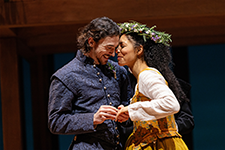 Maggie O'Farrell's novel Hamnet was adapted by Lolita Chakrabarti for England's Royal Shakespeare Company, a production that, after its Stratford-upon-Avon staging, moved to London's West End and then toured Shakespeare theaters in Chicago and Washington, D.C.. It also was adaped by Chloé Zhao and O'Farrell for an Oscar-winning film. The play is the truer adaptation.
 The play not only sticks to O'Farrell's narrative as much as time restrictions allow, it also portrays some of the metaphorical elements in O'Farrell's book. For example, the stage set features a loft at center stage shaped like the letter A; at one point, the lighting creates a shadow of that A on the stage floor. Agnes in the book comments extensively on how her new home with William is a mighty A, which had always been her letter. The novel features a single scene of William and his troupe on tour; the play expands the number of scenes of Shakespeare away from Stratford to four, including the ending, and in these he's interacting with his most famous fellow players. The movie limits Shakespeare's interactions with his troupe to just one, and that focuses on Shakespeare agitatedely directing the boys playing Hamlet and Ophelia in the nunnery scene. The singular character of Agnes's brother Bartholamew gets a closer presentation to the novel in the stage version than the film. In the American touring production, Troy Alexander was a true giant of a man, and his lines adhered more closely to the book than the film's Joe Alwyn.
The film nevertheless picks up the spirit of the book, especially in the presentation of Alwyn's Bartholomew. The role of the forest in Agnes's life gets ample film time. But the movie meanders from the book's intentions with the final Globe Theatre scene. Granted, the only shortcoming I found in O'Farrell's novel was its abrupt ending. That was because the stage play I had seen before reading the book had such a powerful final moment that wrapped up the Agnes-William relationship that would last another 16 years. The movie punts all of that in favor of a surreal scene of community love for A) Hamlet, B) Hamnet, C) Hamlet, or D) all of the above. It was more melodrama than metaphor, emotionally impressive, but not O'Farrell's Hamnet, which is focused more on Agnes and her son, not Shakespeare and his play.—EM
Above photo: William (Rory Alexander, left) and Agnes (Kemi-Bo Jacobs) in the wedding scene during the Royal Shakespeare Company's production of Maggie O'Farrell's Hamnet at the Chicago Shakespeare Company. Photo by Kyle Flubacker.
Another topic O’Farrell delves into is mental health, specifically depression: William’s bouts of depression early in the novel, and Agnes’s later. Agnes manipulates William's travels to London in the first place as an agent for his father’s business but with the purpose of getting him away from his abusive father and the confinement he’s feeling in Stratford. He gets into the playhouse scene by selling the players costume gloves. Later, their son’s death drives Agnes into obvious massive depressive disorder, a condition the real Shakespeare began exploring frequently in his plays. Just how his son's death affects William is obtuse in O’Farrell’s telling, but she uses Hamlet’s soliloquies from Shakespeare's play to suggest they represent what he has been going through in the intervening years (Hamnet died in 1596; Hamlet debuted around 1600). Shakespeare’s grasp of mental health issues, from “madness” to senility to mental disabilities, is astoundingly knowing for his time. In like form, Antonio’s description of depression at the start of The Merchant of Venice (circa 1597) is the most astute I’ve ever read or heard, the secret handshake people with depression share.
Despite Hamnet’s subtitle, A Novel of the Plague, O’Farrell doesn’t focus much on the disease that ravaged Europe in waves during the Middle Ages. She does, however, devote a full chapter tracing step by step the disease’s transition from a sailor in the Eastern Mediterranean to Judith Shakespeare. The chapter emphasizes the degree of happenstance, luck, and maybe fate in how the plague ultimately visited the Shakespeares’ household and took only one life. It’s a trail that can take us to multiple outcomes: the writing of Hamlet, foremost, but also the very existence of William Shakespeare himself. In his book, The Year of Lear: Shakespeare in 1606 (Simon & Schuster, 2015), James Shapiro delves into Shakespeare’s relationship with the plague. The playwright survived an outbreak in Warwickshire when he was a child and many more outbreaks over the course of his life, including living in a London parish that had remarkably few fatalities during a 1606 outbreak. Was Shakespeare immune? Was he lucky? Were we lucky? O’Farrell only scratches at that notion.
Eric Minton
May 17, 2026
Reader Comment
Your note about "Shakespeare wrote incredibly strong and complex women in his plays…These characters nevertheless started in his imagination, and the strong woman trope goes back to his earliest plays" reminded me of something I refer to as "Boyle's Law" (with apologies to the physics community). When I was in grad school, my colleague Francis Boyle declared that "Antony and Cleopatra is a play about how sexy smart women are." We subsequently expanded it to apply to virtually the entire canon. If you're not sure what's up with a woman in Shakespeare, try looking at it through the lens of Boyle's Law and it all starts to get clearer.
My other note or question comes from a comment right afterward, where you state that there's no thematic or historical reason for Margaret to be in Richard III. While I'll grant you that she probably shouldn't be there historically, I take issue with the idea that her appearance makes no sense thematically. Richard III is a play about maternal grief, rage, and power. The word "womb" appears in that play more than in any other play in the canon (even if you ignore euphemisms like "nest of spicery" (ew)). To me, the crux of the play is the scene where all the women are echoing each other's grief: "I had an Edward til a Richard killed him. I had a Richard til a Richard killed him" and then Queen Elizabeth begs Margaret to teach her how to curse her enemies. The response is, basically, "Get in touch with your grief and then you'll know how." The play starts with Margaret cursing everybody because she is so mad about the death of her son, and then at least two times, somebody is being led off to their beheading and their last words are "Now Margaret's curse is fallen upon our heads." This is usually cut in performance, which I think is an effort, conscious or unconscious, to neutralize her extraordinary power. Apologies for a little rant, but that comment touched a nerve!
Aili Huber
(More on this topic is at https://ailihuber.com/2019/04/04/all-violence-is-misogyny/)
Comment: e-mail editorial@shakespeareances.com
Start a discussion in the Bardroom
