


 Find additional Shakespeareances
Hamnet
Theatrical Alchemy
By Maggie O'Farrell (adapted by Lolita Chakrabarti)
Royal Shakespeare Company, Shakespeare Theatre Company Harman Hall, Washington, D.C.
Thursday and Friday, March 19 & 20, 2026, D–111 (front stalls), R–6 (rear stalls)
Directed by Erica Whyman
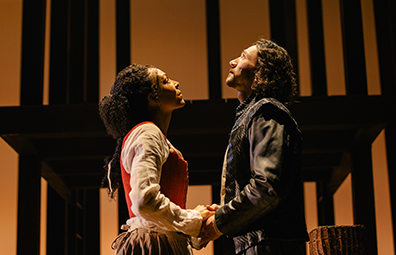
Kemi-Bo Jacobs as Agnes (left) and Rory Alexander as William reach a state of "quintessence" in the Royal Shakespeare Company's production of Maggie O'Farrell's Hamnet adapted by Lolita Chakrabarti playing at the Shakespeare Theatre Company in Washington, D.C. Photo by Kyle Flubacker (courtesy of the Chicago Shakespeare Theater)
Theatrical alchemy is the kind of stage magic that, after seeing a play two nights in a row, inspires desire upon waking up the next morning to see the play again—that very next day. Matinee? Evening? Both.
The Royal Shakespeare Company’s production of Maggie O’Farrell’s Hamnet, adapted by Lolita Chakrabarti, is such theatrical alchemy running at the Shakespeare Theatre Company’s Harman Hall in Washington, D.C., through April 12.
We’re not talking magicians’ tricks, special effects, or slight-of-hand, except for two slaps by hands. Hamnet's alchemy evolves through Chakrabarti’s inside-out script and director Erica Whyman’s continuous-movement pacing, including the cast’s exquisitely choreographed scene changes (Ayse Tashkiran is movement director). When the action pauses, life changes course. This alchemy is constructed upon designer Tom Piper’s seemingly simple but thematically complex, all-wood set of platforms and pillars. An elevated platform and its angled ladders create a large “A” at the center. For such a bare structure, it delivers amazing dexterity to become whatever the scene needs enhanced by lighting designer Simon Baker’s unobtrusive yet emotionally poignant atmospheres. The alchemy takes further shape in composer Oğuz Kaplangi’s dramatic interlude scores and sound designer Simon Baker’s sometimes precise, sometimes spectral aural effects.
Most of all, the alchemy unspools through the talents of a company of actors who, top to bottom, are solid in fundamental acting skills, character details—even during those rapid scene changes—and delivering dialects and Shakespeare’s lines to be easily understandable and clearly audible. That last is a mighty feat in Harman Hall.
This brisk 2 1/2–hour production, including a 15–minute intermission, is not the multi-Oscar nominate movie played out on stage. It’s a different kind of magic. The Chloé Zhao movie’s screenplay (written by Zhao and O'Farrell) is significantly different from the play's, though both have difficult birthing scenes and a death scene you must sit through. The movie is more melodramatic and accessible whereas the play encompasses your soul as you live vicariously through the characters in their Stratford homes and on their London stages. The film earned Jessie Buckley a no-doubt deserved Oscar for her portrayal of spitfire, grief-stricken Agnes. In the play, Kemi-Bo Jacobs plays Agnes as a woman fully in touch with her spiritual essence, defiantly so given the Stratford culture in which she was raised. She enthralls William (Rory Alexander), who makes an effort to know everything about Agnes. He thus respects her perspectives, channelling them into the plays he writes. On the screen, Paul Mescal provides a sedentary characterization of Shakespeare. On the stage, Rory Alexander plays William’s life with pinpoint authenticity through its many stages: a teen-age boy, a young newlywed and glover’s son, a rising playwright full of uncertainty, a confident actor. But he always is William in these various phases; or, as Agnes says to daughter Judith, “I think we are always the same person, but we choose to show different faces.” While the film has the luxury of taking the story to many settings, the play turns one set into many places. The film uses a real hawk to play the hawk. The play uses Hamnet to play the falcon.
Movies may be more immersive because of their visual realities, even in green-screen fantasies. Stage plays are more spontaneous because they are live and thus relying on that day’s actors’ and audience’s temperaments. Theater audiences also become part of the show in most Shakespeare plays, including this one about a Shakespeare play. When Agnes and her brother, Bartholomew (Troy Alexander), arrive at the Globe theatre in London, he chooses to leave. “Too many bodies in a confined space. It’s unsettling,” he says directly referring to the Harman Hall audience.
This Hamnet's immersive qualities go far beyond being part of the live theater experience. As its characters grow and evolve, we evolve with them as do the play's metaphorical visual and aural through lines. Those through lines tie up beautifully during the final scene’s conversation between Agnes and William. The emotional impact of the moment is a pincer movement of the mental metaphorical journey we have taken and the heartfelt sense of becoming close kin to the Shakespeare and Hathaway families through the births and grief we've shared.
This takeaway comes twofold via my deeply personal perspectives. I have participated in two births, and I share in the kind of grief both Agnes and William and the rest of the family suffer. While their grief is from Hamnet’s sudden death from pestilence, mine is through my wife’s prolonged death by Alzheimer’s. I grasp the sense of spiritual peace they arrive at through Agnes’s spiritual gifts and William’s ability to capture those gifts in words. Meanwhile, as a Shakespeare fan, I find their closing conversation’s revelation of what makes Shakespeare Shakespeare most profound. Agnes, at the Globe in London to see her husband’s new play that she believes crassly capitalizes on their son’s name, learns that through Hamlet, William is uncorking everything he has kept bottled up in the time since their son’s death. More than that, William has weaved her grief into his play and resurrected their son in doing so.
“I write what I cannot say,” William had told Agnes at their first meeting. This truth comes full circle in the play’s final scene. “What is quintessence?” Agnes asks William, a word Hamlet uses as he describes his melancholy to Rosencrantz and Guildenstern. William recalls first meeting Agnes and how she described that “her mother was like the light in the forest, a fragment of unending brightness. Quintessence is that, the spirit extracted out of anything, the highest of elements.” Agnes has been his source of inspiration from the moment they met, and that realization she turns around. “That first time, I felt this, all of it," she says, "but I couldn’t speak it, I didn’t have the words. But you, you William, you possess them completely, and you have written him and make him live again”—"him" being Hamnet who, indeed, is there with them, in a way that both chills and stills you. In their unique means and with each other’s unconditional support, Agnes and William achieve what both need and want from and for each other: it’s been there all along, but only now do we see that quintessence.
Though the story is not historical, and the scholastic link of Hamnet to Hamlet is speculative, the historical record of Shakespeare is cleverly woven into the script. The play could be a drinking game—as long as you have a lid on your drink in the theater—in the number of phrases and lines that echo lines and phrases from Shakespeare’s canon. Scenes, too: we see the origin of Hamlet’s graveyard scene. We also see two thematically apt plays rehearsed: Romeo and Juliet and The Comedy of Errors, albeit out of the historical sequence. Shakespeare wrote and staged Errors before R&J, but the play's sequence follows William's and Agnes's story from their forbidden love to their twins' births and the thematic ramifications that accompany that path as Agnes's visions saw them having only two children.
In terms of Shakespeare depictions, this is the most honest I’ve seen, that honest admittedly being a measure of how I regard Shakespeare. As played by Rory Alexander, Shakespeare is no supernatural genius. He is equal parts observant and respectful, listening to and watching others without judgment. He lacks in self-confidence but ventures into whatever challenge is thrust upon him, be it marriage, fatherhood, a sales agent for his father’s gloves in London (whereupon he finds ready customers in the playhouse actors there), a playwright, an actor. The subtlety with which Alexander matures his character through the years is masterful, as is his juggling William’s personas as playwright, theatre entrepreneur, character actor, and a father, at one point all in one scene. William thinks A Midsummer Night’s Dream “lacks weight,” though Will Kemp (Nigel Barrett, who also plays William’s father, John) considers it “one of your finest and will make our glut of a landlord rich.” William worries about his latest script, too, but he becomes notably richer himself after that play, Romeo and Juliet, hits the stage. “I have nothing to give. Just myself,” he tells Agnes as they agree to marry. “That’s more than enough,” she replies. Amen!
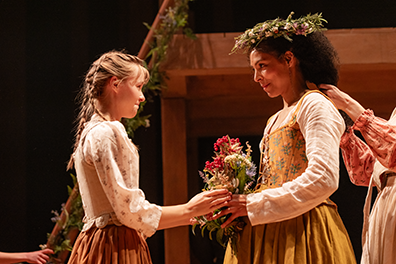
Above, Eliza (Heather Forster, left), William's sister, has made Agness (Kemi-Bo Jacobs) her wedding crown in the Royal Shakespeare Company's production of Magie O'Farrell's Hamnet, adapted by Lolita Chakrabarti. Below, Hamnet (Ajani Cabey, right), comforts his plague-stricken twin sister, Judith (Saffron Dey), as they watch Death approach from the corner of the room. Photos by Kyle Flubacker (courtesy of Chicago Shakespeare Theater)
For Hamlet's opening performances, William decides to give the title role to the young Thomas Day (Ajani Cabey) instead of Richard Burbage (Bert Seymour). Historically, Burbage played Hamlet, and in this play, his fellow actor Ned Condell (Karl Hanes) tells him, “I imagine it’ll come to you soon.” Chakrabarti's device here serves as a plot point as well as metaphorical machina. William wants the young man to speak his lines, perhaps in anticipation that Agnes will be in the audience. This creates a fourth-wall-breaking moment for the audience, for in addition to playing Thomas Day in Hamnet's play-within-the-play production of Hamlet, Cabey plays the title character of Hamnet. Thus, playing Hamlet at the Globe is the actor playing Hamlet’s namesake, Hamnet, while Hamnet’s father, William, is playing the Ghost of Hamlet’s father in Hamlet. Talk about nesting metaphors. The production doesn’t mask this fourth-wall-breaking irony at all. Indeed, it is a very Shakespearean thing to do as Shakespeare appears to have used doubling for plot and metaphorical purposes himself. It also allows Hamnet as Hamlet to speak on behalf of William directly to Agnes as he describes how, “I have of late—but wherefore I know not—lost all my mirth.”
The title character, Hamnet, is not the play’s lead. Agnes and William are the leads in Hamnet’s play, and Jacobs’ and Rory Alexander’s performances alone make the production worth seeing. Cabey, though, is almost their equal in what he achieves in this production. He plays the pre-born Hamnet, the childish boy, the 11-year-old Hamnet doing his best to take care of his sick twin sister Judith (Saffron Dey), and the dying and dead 11-year-old. He also plays his mother's falcon. All are affecting portayals. Then, Cabey stuns as a Shakespearean actor playing Hamlet. We may be experiencing in nascent form the next generation’s great Shakespearean actor in a long line running back to the real Burbage, the actor that Cabey’s Thomas Day displaces in playing Hamlet in Hamnet.
The play, like O’Farrell’s book (which I have not read) centers on Agnes, Shakespeare’s wife, Anne Hathaway, but spelled with a “g” though the “g” is soft, making malleable “n” the prominent sound at the syllabic juncture. From Jacobs’s first appearance running on stage swirling a bait on a string for her falcon—and Cabey as that falcon, runs on stage diving in and out through Jacob’s swirling—her Agnes drives both the plot and the play’s allegorical substances. Chakrabarti's script dictates the racial makeup of the cast, assigning "mixed heritage" to the Hathaways and Agnes's and William's thee children, a thematic image establishing their status as "others" in the otherwise white Stratford population. Jacobs further gives a Caribbean edge to her Warwickshire country-folk dialect, delivering her lines with studied urgency, power, and poignant grace. She and Rory Alexander establish both a cunning and loving repartee from the start. Yet, while Alexander executes a subtle portrayal of William’s evolution over the course of the play, Jacobs's Agness adapts her story's circumstances to her steadfast persona: excepting the manner of Hamnet’s death. Her story totters on the verge of unravelling at that point, and it takes William's patient vision and her angry reaction at learning her husband, who rarely visits, has been "secretly plotting to use our son's name for a pageant, a meaningless revelry."
Though this review highlights Jacobs, Rory Alexander, and Cabey, my assessment of the entire cast is best put this way: I’ve been attending Royal Shakespeare Company productions in England and New York since 1977, including during two of the company’s golden ages in the late 1970s and mid-1980s. The cast for Hamnet touring the United States (it had a run at the Chicago Shakespeare Theater before arriving in Washington), is the most thoroughly solid RSC company I’ve ever seen:
- Troy Alexander as Agnes’s brother, Bartholomew, is a large, simple man people don't want to cross, but he always displays a heart of great love and serves as the true humanist anchor of the play. In nuanced ways he proves to be every bit his mother’s son as Agnes is their mother’s daughter. A nice moment audiences may overlook comes when the attendees to Agnes’s and William’s wedding dance after the ceremony. Bartholomew pairs with Will’s younger sister, Eliza (Heather Forster): that’s just such the right thing to do. Of any character I’d love to do happy hour with, it’s not Rory Alexander’s William but Troy Alexander’s Bartholomew. Well, both: William and I can talk about all things Shakespeare while Bartholomew nods appreciatively that his sister got it right.
- Barrett as John Shakespeare, William’s father, is a smart-to-the-point-of-devious and crass-to-the-point-of-violent glovemaker, which he insists makes him an artist as well as a gentlemen (thus the irony in William achieving the coat-of-arms for his father). Barrett also plays a self-serving, egotistical Kemp under the cover of a bonhomie gentleman.
ASIDE: What it is Like to Write Like Shakespeare
 The character of William in Maggie O'Farrell's Hamnet adapted by Lolita Chakrabarti is one of two wonderful depictions of Shakespeare I've seen on stage who describe what it takes to write like Shakespeare. I'm no Shakespeare, but I am a writer who has spent the bulk of my lifetime earning money practicing my craft, and both depictions deeply resonate with me.
Here is how William, Hamnet's father (Rory Alexander), describes the process.
I'm in the center of it waiting for it to reveal itself. I must linger and it'll emerge. It's close. And with luck, tomorrow or the next day, I'll feel my way like, like a blind man on a tight rope, not knowing how far I may drop and then with the fire of a galloping horse, I'll write, scribbling at speed and fear of losing the thread. It comes from somewhere else, I don't know where, and I am a willing, but clumsy midwife—holding a thought I once had, a person I met, a feeling I sensed, and I'll write and write 'till my hand aches, my eyes blur, my insides are out, and I'm living in this other world where I am God. And at the end of it, or the end of me, or the end of day, I'll stop, then I'll return to my desk and do it all over again.
The way Burbage and Kemp are looking at him after this revealing reverie earns laughter from the audience, but, frankly, it is not funny or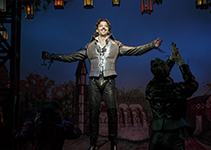 fun to William.
Nor to the Will Shakespeare in the fun Broadway musical Something Rotten, a sendup of both Shakespeare and musicals. The musical's original Shakespeare, Christian Borle, who won a Tony for his performance, perfectly summed up the act of writing in the song "Hard To Be the Bard."
I know writing made me famous
But being famous is just so much more fun.
You see, what people just don't understand
Is that writing's demanding
It's mentally challenging and it's a bore
It's such a chore to sit in a room by yourself
Oh my God, I just hate it!
And you're trying to find an opening line
Or a brilliant idea and you're pacing the floor
And hoping for, just a bit of divine intervention
That one little nugget, that one little spark
Then, Eureka! you find it, you're ready to start
So now you can write, right? Wrong!
You're not even close, you remember that, damn it
Your play's gotta be in iambic pentameter!
So you write down a word, but it's not the right word
So you try a new word, but you hate the new word
And you need a good word, but you can't find the word
Oh, where is it? What is it? What is it? Where is it?
Which leaves him nonsensicalling babbling until a servant interrupts him.
To sum up, I'll quote one of my professors and career mentors at the University of Missouri Journalism School who said that anybody who claims they love writing are crazy or don't write for a living. "You don't enjoy writing," he said; "You enjoy having written." Amen! — EM
Top photo: Rory Alexander as William with Kemi-Bo Jacobs as Agnes in the background in the Royal Shakespeare Company production of Maggie O'Farrell's Hamnet adapted by Lolita Chkrabarti. Photo by Kyle Flubacker (courtesy of Chicago Shakespeare Theater).
Above photo: Christian Borle as Will Shakespeare in the Broadway musical Something Rotten!, Book by Karey Kirkpatrick and John O'Farrell, music and lyrics by Wayne Kirkpatrick and Karey Kirkpatrick. Photo by Joan Marcus, Boneau/Bryan-Brown. - Penny Layden as Mary Shakespeare, William’s mother, is set in her cultural and religious upbringing and yet a spirited individualist. You can see her influence in her son, not just the William in this play but the real Shakespeare who wrote so many plays with strong women characters. Between Layden’s Mary and Jacobs’s Agnes, you can see why William turns out the way Shakespeare did.
- Ava Hinds-Jones as Susanna, Agnes’s and William’s first child, displays hints of jealousy toward the twins, especially Judith, but she’s a hard-working girl and steadfastly loyal to her family.
- Nicki Hobday earns villain-playing kudos as Joan, Agnes’s and Bartholomew’s stepmother. She is an arrogant bully and openly cruel, deserving all the hate she gets: “I hope that old crone shrivels up and dies,” Susanna says. Hobday nevertheless gets to the broken heart of a woman who wheedled into a marriage promising stature and financial support but never will attain that stature of being a landed lady in her own house. Though blinded by hate, she is deeply hurt that she can’t earn the love of her stepchildren, never understanding their ongoing fixation on their late mother, who was known to be a witch (that's spelled correctly).
- Forster’s Eliza is smart as a whip and William’s most prominent supporter, especially in his absence. She’s ever oozing with love for her big brother and all that’s his: Agnes, their children, his talents.
- Seymour earns one of the production’s biggest laughs speaking his first line before we even know whom he’s playing: “Why must I always die?” That pretty much identifies him as Burbage before Kemp addresses him as such in the next line. In this instance, Seymour’s Burbage is playing Romeo (Shakespeare is playing Tybalt, Kemp is playing Friar Laurence—good casting choices). Seymour plays the most famous actor of his day without an ounce of arrogance and displays unending respect for William.
- Haynes, in addition to playing the fumbling actor Henry Condell, plays John’s apprentice, Ned, a generally quiet and congenial soul. That’s in contrast to his fully masked Physician who speaks deathly thunder.
- Tilly, the Shakespeare’s maid servant, is something of a nothing character, and Elizabeth Connick delivers on being something of nothing. That takes skill, and thus I’ll point to her as exemplary of the cast's duties in carrying out scene changes in character, as Connick’s Tilly remains unmotivated in character yet efficient in practice.
- Matilda McCarthy has multiple roles, foremost as Jude, a steady friend of the family for whom Judith is named. She has a brief appearance as the Physician’s wife, and she is William’s Landlady in London. Her Landlady may or may not be having an affair with William but certainly wants to and behaves toward Agnes as if she is—not that Agnes cares.
Though Agnes accuses William of having affairs, and William takes note of the landlady’s interest in him, the play offers no evidence that he is engaging in infidelity. Besides, he knows trying to convince Agnes otherwise can come only from his showing her how fully he has incorporated who she is and what she offers him into his every being, as a husband, as a father, and as a man of words. He succeeds in all three.
Eric Minton
March 28, 2026
For my review of the movie Hamnet, click here.
I just ordered O'Harrell's novel and will post a review of the book In Print when I finish reading it.
Comment: e-mail editorial@shakespeareances.com
Start a discussion in the Bardroom
© 2011–2026 Eric Minton
All Rights Reserved
Shakespeare Canon Project: 42 Plays, 42 Theaters, One Year
©2018-2019 Eric Minton, All Rights Reserved
On Stage On Screen On Air In Print Commentaries Dialogues Shakespearecure
Bard on the Boards Theater Links Web Links Shakespeare News Productions Seen Shakespeareances.com Top 40
Home Updates About Standards & Etiquette Sponsorships Terms & Conditions Contact
