


An Interview with Sir Trevor Nunn
White Boxes, Shakespeare Musicals,
and a Novel-ty Play Rounded With a Dream
By Eric Minton
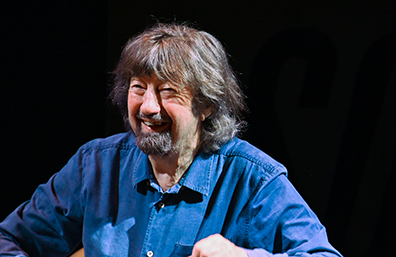
Sir Trevor Nunn . Photo courtesy of Trevor Nunn.
My dad was an Air Force chaplain, and my parents were stationed at RAF Lakenheath, England, when I started college at the University of Missouri in 1976. In the summer after my freshman year, I visited my parents along with my girlfriend, a high school romance that was still going strong even after a year's separation as she was attending Rutgers University in New Jersey. She was a Shakespeare fan; me, not so much. My parents loved theater of any sort and had discovered the Royal Shakespeare Company (RSC) and intended to share that experience with us.
The first play we saw with them was King Lear at London's Aldwyich Theatre. A well-established English comic actor, Donald Sinden, played the title role, a controversial casting choice. I've seen 22 Lears since, and Sinden remains a standard matched by only a couple of those and surpassed by only one.
The man who directed that production and cast that Lear was Trevor Nunn, then the RSC's artistic director. After groundbreaking years at RSC and other singular theatrical successes, he is now Sir Trevor Nunn. Over the ensuing years I would see several of his works on stage and television, and hear descriptions of other Nunn productions from my parents, especially my father.
At the 2023 Blackfriars Playhouse Conference in Staunton, Virginia, Nunn was attending to receive the American Shakespeare Center's Burbage Award "for achievement in expanding the love of Shakespeare through the production of his plays" and to give a keynote speech. I secured an interview with Nunn for Shakespeareances.com in the early afternoon of Saturday, November 4, meeting up at the Staunton Innovation Hub in downton Staunton after he arrived from England the evening before.
Born January 14, 1940, in Ipswich, England, Nunn started his theatrical career at a theater in his hometown when he was still a boy. He went to Cambridge University where he became involved in a student theater group that included Ian McKellen and Derek Jacobi. He also directed the college's Footlights Revue, an annual comedy show; his particular turn at the helm turned out to be the genesis of what would become Monty Python.
Nunn joined the RSC in 1964 and became its artistic director four years later. Taking over for Peter Hall, his mentor, Nunn was determined to expand the innovative standards Hall had established in staging William Shakespeare's plays. Nunn would later serve as artistic director for the Royal National Theatre and currently for the Theatre Royal Haymarket. He has directed all 37 plays in the traditional Shakespeare canon, the last at his hometown Wolsey Theatre in Ipswich rounding out his Shakespearean career with the first Shakespeare play he saw as a boy in a school production.
Nunn famously turned a Shakespeare title into a bona fide musical, but this was after he discovered that, in his eyes and ears, Shakespeare himself had invented the musical. He then went on to be the inaugural director of two of the most successful musicals ever produced, Cats and Les Misérables. We discussed neitheer in the interview (except a brief mention of Les Mis). Instead, we dove into a play that was my father's life favorite theatrical moment, a production that Nunn himself called "So, so, so, so climactic in my life, in my career" and single-handedly pulled the RSC out of an existential financial crisis.
My parents, so important in my path to Shakespeareances, provide the bookends and thread of knowledge through this interview, after which Nunn remarked, "It's just fantastic that you know so much and saw so much. I can't believe it. I had no idea that was going to be our conversation." Thank you, Mom and Dad. In the following Q&A, I've cut introductory talk at the beginning and banter at the end, and the rest has been edited for accuracy and grammatical flow while staying true to the recording transcript.
[Shakespeareances:] I have to throw in the personal part of this. My father was a huge fan of yours. He was in the Air Force, he was stationed in England, they were there in the 1970s.
[Sir Trevor Nunn:] Where in England?
They were at (RAF) Lakenheath.
Lakenheath I've been to. That's East Anglia, isn't it? Well, I was born in Ipswich. So there was RAF Bentwaters, and a little further away Lakenheath.
And then Mildenhall. My wife and I were at RAF Mildenhall.
Mildenhall! Well, I've been to all of those places. Isn't that extraordinary? What a small world.
And talking about Ipswich, Mom and Dad went to the Ipswich theater.
So did I.
Where they saw Ian McKellen do his one-person show.
Well, Ian McKellen pretty much started his professional career in Ipswich playing Henry the Fifth. But I beat him to it.
I started my professional career in Ipswich when I was 13 years old. I happened to read a paragraph in the local newspaper, and most evenings I didn't read the newspaper at all, but I saw this paragraph saying that the local theater was searching for a local boy to play the youngest son in a play called Life With Father, and auditions were to be, and I just took note of this, and I didn't tell my parents. I went after school to these auditions, and then they asked me to come back three days later, and I still didn't tell my parents. I did go back, but by then I was reading a section of Oliver Twist by Charles Dickens for them, and they then said yes, we want you to play the part. So, I then had to beg my school to let me attend rehearsals. The local newspaper made a huge fuss over me: a local boy is going to be amongst the professional actors. My father in this play was played by Paul Eddington, the young Paul Eddington who became hugely famous, he became a household name in the UK later on.
Completely life changing. Life changing because you just happened to read a little paragraph in a newspaper. Totally life changing.
And your parents supported it, I take it.
Well, we lived in a little working-class house on a little working-class street. So those parents do not oppose children going into the theater. It's only people who are wealthy, middle class and upper class, who oppose the theater. Poor people say, "Go for it! Go for it! Try to get out of all of this that we're in. Anything to get out."
My son is an actor up in New York and he has a good job in human resources, and I keep telling people I'm probably the only father out there who says, "You know this corporate stuff is all fine, but you really should get back to acting."
Get back to acting!
Because he's good.
Absolutely, yes.
You say it's life changing, but is it also indicative of your attitude and your career?
Hugely so. I was fantastically lucky that I managed, in those days, there was something called the eleven plus. It was a school examination, and if you passed, you went to a grammar school that meant a higher level of education. If you failed, you went to secondary modern school that basically imagined you would grow up to be a shop assistant. I must have scraped through, got to the grammar school, and very early on I came across a teacher [Peter Hewett] who taught English literature, who was so exciting on the subject of Shakespeare. And then I discovered that he was the teacher who directed the school play every year. I was devoted to him. I idolized him. I wanted to impress him always. Eventually in the sixth form [two years of study in grammar school], I'd done lots of school plays and sat with him as he was directing. so I'm incredibly fortunate.
So, your directing chops came early.
Just learning about staging, learning about focus, learning about connecting with the audience and so on. But he then said, "I think you should try for an open scholarship at Cambridge." I said, No, sir, honestly, I'm nowhere near good enough. And he said, "Come on. We will work it out." He gave me extra sessions, early in the morning, lunch time, after school. I would then go out and see him—he lived in a windmill, can you believe it, with his wife and two children—and he would give me an entire weekend of his time. More and more and more and eventually I took the exam, I got a scholarship to Cambridge. Can you imagine how fortunate that is to have somebody like that in your life?
But here's the crucial thing as well. Having got that scholarship, it was then nine months before I could take it up to go to Cambridge. I thought I've got to do something creative. I'd left school, no reason to go on at school, and once again I went to the local newspaper, and they helped me to advertise for auditions for me to form a youth theater group in our town, Ipswich. We did form the Ipswich Youth Theatre Group, and I decided I was going to direct a play, and I thought I'll go for something simple. I'll go for something straightforward. I chose Hamlet.
We did a production of Hamlet in a lovely space in Ipswich called The Art Gallery but was no longer an art gallery but a performing space. It completely changed everything about my determination to be involved in the theater. I had thought it would be wonderful to be an actor, but after that, I only, only, only ever wanted to direct.
Did you play a part in that Hamlet?
I did not. I played many, many parts in productions at Cambridge University, I played scenes with Ian McKellen. How lucky. Derek Jacobi as well was there. I played scenes with Derek. And lots of people who went on to do stuff in the professional theater. As well as, can you believe it, eventually I directed not only three Shakespeares at Cambridge, but I directed the Footlights Revue, the world-famous, crazy Footlights Revue, and I cast two people who had never been on a stage before called John Cleese and Graham Chapman. And a delightful boy called Tim Brooke-Taylor and a girl called Miriam Margolyes. They all became household names in England. Can you imagine?
I knew about the Footlights Revue and that Monty Python came out of it, but you actually directed that show?
I did. Oh yeah. Oh yeah. O yeah. I auditioned them and directed them, and we had the most wonderful, wonderful time. After doing the Revue in Cambridge, we took it to the Edinburgh Festival. That's where people saw Chapman and Cleese and got them involved in a [television] show called At Last the 1948 Show after which came Monty Python.
Did they learn anything from you?
Learn anything? What are you talking about? They learned everything. [He laughs.] I was in the same college as John Cleese. [Downing College; the University of Cambridge is a confederation of 31 different colleges]. John, six foot three, and one evening, about 10 o'clock in the evening, there was a knock on my door in college, and I opened it and there was six-foot-three John Cleese saying, "Ca-ca-can, can I have a talk?" And I said, "Of course, of course, John, come in, come in." And he said, "No, I just want to—do you think somebody like me could become involved in the theatre?" And a year later he was in the Footlights Revue.
Have you finally done your Midsummer Night's Dream?
I have done all of Shakespeare's 37 plays. How lucky can you get?
But you haven't done a 38th, meaning Two Noble Kinsman.
I haven't done Noble Kinsman. It's tricky, isn't it? Because I have done Pericles, and I reckon that's about 25 percent Shakespeare.
I saw your Pericles up in New York.
Yeah, in Brooklyn. We had a lovely time. And I've done Merry Wives. I think many hands were involved in writing that play in a great hurry, including Shakespeare. Henry VIII I reckon is only about 15 or 20 percent by Shakespeare: the Catherine of Aragon on trial speech and Wolsey's death, but a lot of it is very obviously Beaumont and Fletcher. It's just not at the level that we're used to. [Frances Beaumont and John Fletcher collaborated on several early 17th century plays, but Fletcher alone is credited as co-writer with Shakespeare on Henry VIII, as well as The Two Noble Kinsmen.] Compare the opening chorus to Henry VIII with the opening chorus of Henry V [Nunn laughs]. But I haven't done Two Noble Kinsmen because I think only the jailer's daughter scenes are Shakespeare. I think there's terribly, terribly little. I mean, the noble kinsmen themselves, the text is just not at the same level. We're to believe that Shakespeare was a major participant in Two Noble Kinsman in sort of the middle of his career. No, no. [With] the accomplishment that Shakespeare has by then, I don't go for it. I don't believe it.
So, when you said you've done the 37, you said, "How lucky is that?" Is that luck?
It became a determination. I mean, running the Royal Shakespeare Company for 18 years does help. [He laughs]
Yes, it gets you most of them. Although running it you didn't direct, you would only direct one show per season.
Sometimes I did a couple, and one year I did all four of Shakespeare's Roman plays. And I did them, fascinatingly, like an epic sequence, so instead of doing them in the order that Shakespeare wrote them, I did them in Roman chronological order. We started with Coriolanus, we then did Julius Caesar, we then did Antony and Cleopatra, and finally Rome falling apart, Titus Andronicus. So, we would play them in sequence with a very deliberate intention of describing the creation of and the demise of the great civilization.
When you say in sequence, did you do them in one season?
I did them in one season and then I transferred them to the Aldwych [in London] because in those days our two theaters were Stratford-upon-Avon and the Aldwych, though quite soon when I was running the RSC, I opened a small theater up the road, The Other Place [in Stratford], and that allowed us to do "Intimate Shakespeare," which was a revelation. Wonderful. And then that led me to search for some warehouse space in London I could turn into a theater and that became the Donmar. That did okay. And then eventually I opened what I thought was missing in Stratford. I wanted a space that had a feel of a Jacobean auditorium, but a space where we, the RSC, could do all the plays that had led up to Shakespeare and all the plays that Shakespeare influenced in the Elizabethan and Jacobean world. So, we created, thanks to the wonderful, wonderful generosity of an American donor, we created the Swan.
[I misidentified the donor, but Nunn wouldn't correct me.]
No, no, no, no, no, no. He wanted to remain anonymous and I've got to always, always honor that. I mean, it's now a very, very long time ago, and I hear he's no longer with us, but he didn't want his family or their resources to be publicly connected. [The donor has been identified in a public ceremony, but I'm maintaining Nunn's personal intention here.]
And of course, the opening play there, which I attended, was Two Noble Kinsmen.
Yeah, it was the first use of the space by my friend, Barry Kyle [director]. I was slightly horrified after all of the talk that we'd had about doing Elizabethan and Jacobean plays that Barry decided to do a production that was slightly Japanese. That felt very, very strange. But a bit later in the season I discovered a wonderful, wonderful piece of work by Thomas Heywood, nobody had ever heard of it, called The Fair Maid of the West…
.png "Les Miserables program") I saw that, too.
I saw that, too.
…Part One and The Fair Maid of the West, Part Two, and we collated the two plays into one play.
It was a fun, fun play.
I needed a girl in the company who could sing. And I auditioned and found a girl and took the risk and gave her the leading part, and she was called Imelda Staunton, and she's never looked back.
Yep. You know, I've seen her in so many movies, but my image of her is the Fair Maid.
She was just wonderful in The Fair Maid, and that led to me starting also a creative relationship with a composer called Sean Davey, an Irish composer, who I discovered had written some music that he called The Pirate Queen. And I couldn't believe that wonderful happenstance. So, he came to work with us, and he wrote the five songs that Imelda sang. Oh, God, how lucky were we: thrilling, absolutely thrilling.
Let me take you back just a bit. When you opened the intimate space, you wanted an intimate space. Every time I read Antony and Cleopatra, I don't think that's a huge space. I think it's a living room type play.
Antony and Cleopatra?
Yeah, that's how I've always felt about that.
I'm not going to agree with you on that one. I think Antony and Cleopatra's a very large cast play, I mean all the Romans, all the Egyptians, Octavius and his group, you're moving between Rome and Egypt, Egypt and Rome.
I realize that, but I always feel there's like an intimacy.
There are big public scenes like the big Senate confrontation and so on, and there are battle scenes. And battle scenes is always a clue.
And I've just been actually talking about this in public: I think the great tragedy Othello was not written for The Globe. I think it was written for a smaller space because so much of the play is just duologue. It's a much, much smaller cast. The final act is in a bedroom. Everything about that to me says it was written for a candlelit interior space with a much smaller audience than The Globe. I would say that Antony and Cleopatra is written for The Globe in order to have soldiers, battle scenes and so on. Yes, of course, there are love scenes between Antony and Cleopatra in duologue, but there's always other people hanging around. There are always the Cleopatra maidservants and Enobarbus and so on.
But one of your greatest productions was Macbeth with McKellen and (Judi) Dench [first staged at The Other Place.]
Well, that's totally, totally different. I mean there again, I'd done the play in university. I did the play in a main house production at Stratford with Nicol Williamson, and then converted that into a slightly more small-scale production that we did for Nicol at the Aldwych, we kind of contained it much more. And then, a few years later, in conversation with Ian McKellen and Judi Dench, I was trying to get them to come to Stratford, and they said, "We've been talking and we will come to Stratford if you will let us play," him and her, "Macbeth and Lady Macbeth." And I immediately said I can't think of anything more exciting, and they said, "Well, there is something more exciting. We will do it if we can do it in your new small theater."
So that was their instigation!
It was the dream for me because I was beginning to think small-scale, intimate Shakespeare, and what we're doing in The Other Place can change so much of what we have been doing in the main house at Stratford. Because when you're in the small scale then psychological subtext, contradiction, it all comes in so, so much more potent because you can see the expression on every face, you can see the thought behind the eyes.
So, we had a wonderful time rehearsing the small-scale Scottish (play). It's always thought of as very, very bad luck, and I thought I'm going to go for this even further, I'm going to have a cast of 13 people. [He laughs.] Unlucky 13 doing that play: 13 doing a radically scaled-down version of that play, But being able to do things like the pre-murder and the post-murder scenes in a whisper, him and her whispering together, and everybody in the audience being able to hear those whispers to the point where I think one of the best plays ideas I've ever had was Ian and Judi on stage, and we had a black curtain surround so that we were in a black box at The Other Place, but it was possible for the other acting company members to get behind that black surround, all the way around the auditorium. So, 11 actors had positioned themselves completely unknown to the audience, and as that scene [Nunn whispers, which the recorder doesn't pick up], all the actors in the company were just going [snores and deep breaths], a sleeping household, [he whispers:] it was devastating. [He comes to full voice:] Absolutely devastating that any given moment, one of those sleeping figures could have woken up and then he would have been caught red-handed and there he was with the daggers. It was so thrilling to work in it.
And it also meant doing things like Banquo's ghost. It was an obvious decision to make the extra figure at the table invisible. I didn't have Banquo wearing strange gray costume in a weird light. It was only in Macbeth's mind. It was only in his imagination and everybody thinking what on earth has happened to him, and Lady Macbeth having to cut off this weird, weird outburst. It was so much more appropriate in that small production than, oooh, weirdy, weirdy, weirdy ghost is coming in.
How many seats were in The Other Place?
It would vary. I think we could get it up to 200, three-sided, and we put a balcony row in, a gallery row. But you must understand it was a shed. It was a metal Anderson shed.
Here is something that everybody needs to understand about the theater. It's inexplicable that some spaces have got magic. Some spaces have an acoustic and have a sense of focus and anything is possible. Some wonderful contemporary spaces in thrilling new buildings and so on, the acoustic is terrible and it doesn't happen, the incredible excitement doesn't happen. How can you explain it? I don't know. The Other Place was a shed that had the best acoustic ever, ever, ever. I don't know how that came about, but I remember doing Othello in The Other Place, and I outrageously took an interval just after Desdemona had dropped the handkerchief. And so, the stage cleared and there lying on the floor in the courtyard was a handkerchief. Part two started with Emilia sitting, and it was I think nineteenth century, and she looked at the handkerchief and then she struck a match and it lit a cheroot, and everybody in the building could not only see that she was looking only at the handkerchief, but everybody in the building could hear crrrrrrkk-sssshshsssssss—whhhooooooo. [He whispers}: "What is that handkerchief going to do?" It was so, so exciting that striking a match could be a thrilling sound effect.
We never quite got that in the Donmar. And then, oh! heartbreakingly, I had to fight, fight, fight, but RSC governors, because we were to move into the Barbican—that was all arranged long before I took over—and there was no small theater. I had to fight to get the board to agree to the architects creating a small theater out of one of the rehearsal rooms they had provided. And that meant they had to put in a lift and stairs and so on for the public to go down to it, so it was expensive. I'm thrilled that we got a small theater, but it didn't have that acoustic, it just didn't have that wonderful ingredient. I was hoping and praying that it would, but it didn't.
It was in a concrete shell. You talk about some of the great thrilling things you've done. Is there any particular play that is, as a director, as what you achieved, that is a standout for you?
Well, that is an impossible question because always in the past when I'm asked what is my favorite Shakespeare, it's the one I'm currently working on. [He laughs.]
I realize that, but I'm asking is there something that really touches your heart.
I can answer that. It's mixed up, to some extent with revolutionary design, to some extent with the company of the people I was working with, to some extent a moment in the RSC's history where so obviously some kind of movement forward had to happen again. In 1969 I organized a season that would contain a number of the late plays, and I chose to do The Winter's Tale. And that season was given in what everyone came to know as the white box. It was the white box that Peter Brook then used for his Midsummer Night's Dream in 1970. I mean, it was revolutionary. It was designed by a guy called Christopher Morley. A pure white box and a white carpeted stage space and a huge downlight over the entire space that could be bright daylight or could just dim until it was evening, until it was night, and then just occasionally we would use a follow spot. Everything else was this overhead lighting that we knew as Apollo: we called that whole lighting box up there Apollo.
And I did The Winter's Tale in that white box. It gave fantastic freedom to be able to do a production that to some extent looked futuristic, to some extent looked contemporary, that could have absolutely thrilling physical life. Shakespeare in the pastoral sequence I think is the inventor of what we have come to know as the musical. In that sequence, Autolycus sings and then Autolycus sings again and then Autolycus and the Shepherd Girls and then everybody is at the dance and then there's another collective song and then Autolycus again. It's music, dance, music, dance, music, dance for an entire sequence. Shakespeare absolutely knew that you could story tell through music, you could celebrate and get a whole audience thrilled because the entire company is dancing.
Okay, so that was one ingredient. But it was also the moment when I persuaded an actress friend of mine to join the Royal Shakespeare Company or got to come back after many, many, many years to the Royal Shakespeare Company, an interesting young woman called Judi Dench [he laughs].
And she played both roles.
We went out to dinner and talked about her coming to play Hermione. Then, at that dinner conversation, talking about the 17-year gap, and there was Judi who was in her 30s but behaved constantly like a teenager, I said I think we could make it work that you could play both, you could play mother and daughter, Hermione and Perdita. Judi agreed, and we had a rapturous time. It required a very particular design ingredient to make it work as Perdita was looking at the statue of her mother in the last scene. It's too detailed to go into, but we managed a conjuring trick that nobody in the audience ever, ever, ever understood. And right at the last moment, Perdita was Judi Dench, and then as the statue was unveiled for the second time, because Leontes had been sobbing and sobbing and so on. "'Tis time, come, come away": The statue that we had previously seen, it was totally a statue, moved, and it was Judi as Hermione. I never, never gave the game away how we achieved it, it was the most wonderful, wonderful conjuring—
You're not going to give it away now.
I'm certainly not, no—wonderful conjuring trick. And people would gasp. I mean, people in the audience, "Ohhh! Oh my god!" And you could hear it. It was everything that Shakespeare dreamed of for that moment, the magic realism.
Why do I say The Winter's Tale is right at the top of the list? Just think, the first third of the play is a tragedy. Absolutely dark, dark, dark, everything is disaster. Hermione is apparently dead, Mamillius is dead. Everything is catastrophic. The child has been banished and is almost certainly dead. Second third, Shakespeare invented the musical, that wonderful pastoral celebration and wonderful comedic musical sequence. And the third era of the play, the final era of the play, is the invention of magic realism. That miraculous things can happen, totally miraculous, overwhelming things can happen that change people's lives.
That's the requirement that you awaken your faith.
Well, in that show we also did a certain amount of coming out to some extent into the audience. It was just the beginnings of that intensity.
Which is a hallmark of the RSC during your time.
Well, we pushed it further and further and further. And I did The Comedy of Errors, of course, the whole company were out in the audience.
So here's my question, which I saw The Comedy of Errors at Stratford. Did you realize that Shakespeare invented the musical while you were doing Winter's Tale? Was that when you realized that?
Yes, yes. I mean, it's partly. I reflect upon it because it was just so exuberant, we had a wonderful company composer, Guy Wolfenden, and Guy wrote streams of music for us. I included some underscoring. It was totally Shakespeare, and because we were partly in the contemporary world, the visual, there just was that ingredient, you just felt, oh, it's like I'm at a musical.
Although we did do one outrageous, outrageous visual joke. At one point, the Young Shepherd comes up running back, the other shepherds have all got dressed up, and they looked very, very much like the cast of a world-famous musical. So, when the shepherd says, "They have made themselves all men of hair," it brought the house down, it completely, totally brought the house down, "men of hair," because they were the cast of Hair.
In doing Winter's Tale, did that kind of influence you to turn a Shakespeare play into a musical with Comedy of Errors? Where did that idea come from?
To some extent, I think that's true. It came from a long discussion with my close colleague John Napier. John had become head of design, and we knew that in that season we were going to be doing together Romeo and Juliet and Comedy of Errors. And we decided, we booked into a hotel in Corfu so that we could talk about Romeo and Comedy, day after day after day, just go through every kind of design possibility. And Romeo we did absolutely 100 percent Elizabethan, and John had created a wonderful wooden permanent space for us. And McKellen was Romeo.
 Which was in itself a kind of a risk doing 35-year-old Romeo and Juliet.
Sure was. But he was so determined that he was going to appear to be 19, and he kind of brought it off, I mean, and the wonderful Francesca Annis [as Juliet].
Anyway, during our holiday discussion, we couldn't resist going to a particular Greek restaurant on the shoreline. And it was a big, open patio. And then we realized there were two restaurants. You could do that one or that one, and that one was brightly colored in red, and that one was brightly colored in blue. And we got fascinated by this, and it became entangled with our Comedy of Errors discussion. Consequently, John created this wonderful contemporary decoration of the Elizabethan space. And there we were, he and I were, as it were, back in Corfu, that whole thing of, in Comedy arriving in a Greek space and huge confusions. And every time we went to that square, where the restaurants were, Greek music was flooding over us and we started to say, ohhh wouldn't it be wonderful to have a musical ingredient. Oh, wouldn't be wonderful if we had some singing in it.
I've always said, I got back to England, and I got on the phone to William Shakespeare, and he said, "Yeah, go for it." He said, "No, by all means, no problem. Yes, of course you can adapt my text into lyrics," he said. And he helped me a lot doing that. [He laughs.] So, yes, disgraceful. We knew that we could be in terrible trouble with the critics. But it certainly didn't matter, what—I mean the audience were in standing ovation mode right from the very beginning in Stratford.
Hard to do in England.
And on and on it went. We took it to London, we took it back to Stratford, we took it to Newcastle, we took it back to London, we televised it. And David Merrick wanted us to do it on Broadway. We had wonderful conversations. Me and David Merrick, can you imagine? It can be great. But Equity would not allow us to bring the company. And I did some auditions, and I found a boy called Kevin Klein, who I thought was talented. But I couldn't find the ingredient of Shakespeare and singing and dancing. I just had to give up. So, it never happened.
I want to do kind of an overall question. You've been doing Shakespeare since you were 13 years old. And I know you're in Cambridge in the early 60s, so you've had 60 years in the performing of Shakespeare. Do you think this has been a significant 60 years for Shakespeare?
It's not a completely straightforward answer to the question in the sense that I think I was hugely, hugely fortunate during my time at the RSC, during my time working in London theater through the middle and later years of the 20th century, hugely fortunate that it was an age of revival. The 20th century wanted to go back and rediscover neglected works, wanted to celebrate the past. So, during that time with the RSC we did Restoration plays, we did Jacobean plays, we did 18th century plays, we did 19th century plays, we did neglected works. We did a (Maxim) Gorky play that had not worked in Russia, but we did it 75 years later and had a triumph with it. It was that wonderful age, and what was central to that was Shakespeare being explored in every detail of the canon. All the rarities were done, all the impossible great cycles—you know, the Wars of the Roses, that whole ingredient. All of that was done and I think became hugely important in the history of Shakespeare performance.
Of course, the fellow in my mind at the center of all of that was Peter Hall. Peter creating the Royal Shakespeare Company, recreating ensemble theater in the UK. He was a genius, an absolute genius. So many of his productions remain definitive. So, how lucky was I—as lucky as meeting that schoolteacher: I sat at the feet of Peter Hall. I was his personal assistant, I was his assistant on so many productions, and then suddenly, crazily, I was 27 years old, he said, "I'm leaving and I want you to take over the company." And I said, Peter, I scarcely know how to run the rehearsal, I can't run a company. And Peter said, "Yes, you can, and you're going to." He announced this in '67, and I took up the reins in the spring of '68.
Terrifying, but thrilling and wonderful.
And you did Winter's Tale in '69.
Yes, yes, yes. I mean, come on, we've got it now, make a statement; that was the white box season. And then Peter Brook I persuaded back to the RSC. I had myself been thinking about a production I was going to do of A Midsummer Night's Dream. That was going to be my next. I had a wonderful meeting with Brook, and he said, yes he would come back, he would come back to the RSC and do something. I said that's fantastic, do you have a play in mind? And he said, well, I was thinking maybe A Midsummer Night's Dream, and I heard myself say yes! Wonderful! [Laughter] And Peter's production went round the world as the most famous production of anything on earth.
Right, aren't you glad that it wasn't yours?
So, I didn't do it until my very, very last Shakespeare, although it was very, very exciting what I was able to do with it.
Who did you do it for?
Because it was the first Shakespeare I had ever seen when I was 11 years old, 12 years old, I saw a school production of A Midsummer Night's Dream, and that got me so thrilled about the theater, and I decided that my final Shakespeare should not only be the first Shakespeare I'd ever seen, but it should be in my hometown. So, the Wolsey Theatre in Ipswich is the most beautiful, beautiful space for medium-scale Shakespeare, absolutely wonderful. And I got focused on something that was frequently cut or frequently ignored in the play, that Egeus very early on says to Theseus, "If my daughter refuses to marry the man I say she must marry, I demand the death sentence." I just think that is so devastating as an ingredient of the lovers going into the forest and how they've got to escape and how in some ways they are saved by the fairies and the spirits and so on, but there is that danger that runs underneath it. I then had the idea, I know what I'm going to do. I set my production in the Raj of India so that I could have complete diversity. I could have a white Lysander and an artist of color Hermia and then opposite Helena and Demetrius and Egeus an Indian elder and working as it were with the Mountbattens in the Indian Raj demanding the death sentence. It meant that I could then have Bottom and the mechanicals all as patron workers in Bombay sitting next to each other and deciding to do a play. It meant, too, that I could have wonderful Indian imagery of fairyland. All of that was a wonderful visual coup. And then at the very end of the play, it is extraordinary that Aegeus is still saying I demand the law and eventually his mind is changed by the play within a play where two lovers are forbidden to marry. I mean—
Whoa!
Oh yeah! Pyramus and Thisbe is the story of the lovers in the dream.
I've seen that play 47 times. I never thought about that.
We had a wonderful—I mean honestly, in this production, which this is probably too detailed, but the end of the play within a play, Bottom kills himself, Thisbe kills herself, and then Theseus says, "So, Wall is left to bury the dead." And Bottom sits up and says, "No, no, no, the wall is down that separated their parents," right? As he said that, and Egeus was watching the play, and his Indian daughter had just got married to a white young man. Theseus looked over to Egeus, the wall is down, and Egeus walked over to his daughter and he blessed her. The audience burst into tears. The play within a play had finally resolved the play.
That's…
It was wonderful.
That's incredible.
It really was. It was wonderful. Absolutely. Everyone got it. Everyone got it. The wall is down.
What a way to end your canon cycle, man.
[Nunn laughs] So that was my last.
Did you do the Much Ado About Nothing with Judi Dench and Donald Sinden? Was that yours?
That was the wonderful John Barton.
That was set in the Indian Raj, too.
Yeah. Oh my God. That was completely, completely thrilling too. They were wonderful together. I mean, I did lots with Donald. Donald did Foppington in The Relapse for me. God, he was sensational. But his Lear.
I saw his King Lear.
I did Lear. Judi was Regan. She did it in Stratford but then she begged out, she was doing too many things and "Am I going to ruin the production if I step out of the Lear?" No, not at all. Come on. Taking care of Judi was more important. But people were full of mockery about the 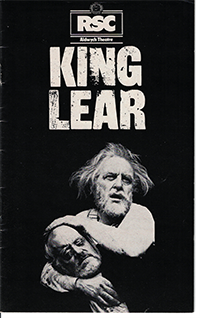 idea Donald Sinden had been cast as Lear. He was wonderful.
He was.
I mean he was very, very unexpected, and he found a degree of naturalism in it that people never expected, I mean, a real conversational ingredient, finding that balance between the pentameter, the verse text, the text that becomes prose, back to verse, and so on, observing all of those rules, and yet making it 100 percent real, that's the challenge.
That was my first RSC production I saw, when I was between first and second year in college, me and my girlfriend at the time.
Wow.
So I didn't know who you were then.
[Nunn laughs.]
I'll ask one more question because, and this is for my dad, my dad's spirit. I knew he was going to come out and interrupt this interview at some point. His favorite theatrical moment, based on how much he talked about it, was Nicholas Nickleby. He never stopped talking about that. And he saw Les Misérables, too, and so did I. I don't know if there's anything to say, I may just be telling you this—
So, so, so, so climactic in my life, in my career. But also, it totally saved the situation.
How did it come about. It's almost beyond belief. I was employing my ensemble company for a minimum two-year contract. Many of them were staying for four years, six years, eight years. You know, Helen Mirren, eight years; Ben Kingsley, eight years; Pat Stewart, 10 years. I mean, it was a wonderful group of people. I had to have a company meeting to say you have all got a two-year contract, and your second year promises you three new parts in London. I've got to be honest with you: you all have the right to leave because I can't honor your contract. I only have one production budget left. And this was the RSC: it was selling out, we were doing wonderfully well at the box office, but we couldn't afford to keep going at that rate of output. I had one production budget. And I said, if you agree to stay, I will try to invent a project that can keep you all involved, but you have the absolute right to leave. And that probably will mean that we will have to close down the Aldwych Theatre operation.
I gave them a week to think about it. Summoned a second company meeting. They all knew if they came to the meeting they were basically communicating we're going to stay. And if they didn't come, I would have to understand, sorry we can't go through with this. I went down to the meeting room. There was an entrance from my side of the building and a company side, and at the appointed time I went through the door, and it was completely empty. It was just chairs and nothing. And then I heard [Nunn snaps his fingers] and then the doors burst open and the entire company ran in: 44 people. At which point I said I think what we can do is to adapt a great novel that will all be on one inclusive set, what one production costs. I'm thinking of a Dickens, and I'm thinking maybe, because it's got wonderful theatrical ingredients, Nicholas Nickleby. They all agreed. No casting had to be announced in any way, shape or form. We had to begin with two weeks of impro, still with no casting: improvisation working out how we could possibly adapt a Dickens novel.
A life-changing experience. We opened it in London. I'm sorry to have to say this about journalists—
I'm used to it.
— but by then [the play] was in two parts. Part one, four hours. Part two, four and a half hours.
On our opening, opening day, got to the end of part one, standing ovation, everybody in the building. Start of part two, as the company once again assembled, standing ovation before they started part two. One big interval in part two, standing ovation for half the audience at the interval. End of show, standing ovation that went on for all of 10 minutes, which is unheard of in English theater, with the audience all flocking down the aisles trying to touch the actors and so on, shouting and cheering and so on.
The press all, as ever, needing to get out ahead of the audience couldn't get out because the aisles were all blocked. They knew there was this vast ovation going on. Two days later, the first review came out, and it was a journalist in the Evening Standard saying it was an interesting idea for the Royal Shakespeare Company to adapt a Dickens novel, but of course it doesn't work. Every review was thumbs down. Every review was, "What are they doing?" "There are so many wonderful German expressionist plays that have not been done, and yet they're messing around trying to do a play from a novel." "This is not a play. This is a disgrace," and so on. We thought we were doomed. Then, queues around the block. And then Bernard Levin wrote a piece called "The English Disease": Why in England, when we discover something wonderful, revolutionary that is going to change everything, do we reject it? We've just done it again, ladies and gentlemen, it's called Nicholas Nickleby.
Queues around the block. Tickets being exchanged for £100 rather than £20, then £200, then £300. Then bring it back, then bring it back again. Then Broadway. Then some people buying tickets for $1,000 when they couldn't get in.
Isn't that sort of the—my last question—isn't that sort of capsulizing a theme that we've been talking here of innovation in theatrical tradition? Because you're talking Shakespeare, you're talking Dickens.
Yep, yep.I'm passionate about innovation. I'm troubled from time to time about how innovation gets mixed up with the agenda, meaning a Shakespeare play can be harnessed to just address one thing in the agenda, the Me Too agenda or the diversity agenda or whatever, but only that. I want Shakespeare to be modernized, I want it to feel contemporary, but I want his complexity, his view of our human condition, close to the angels capable of being beasts. I want all of it, not just one view of it.
Thank you, sir
# # #
Three hours after our early afternoon interview, I was having dinner at Accordia, a wine bistro on Beverly Street around the corner from the Blackfriars Playhouse, when Sir Trevor Nunn and his handler showed up. They were looking for a place to grab dinner, and when Nunn saw me, I invited them to join me, as the bistro was nearly filled, and I was alone at a table for three.
"Are you sure it's alright?" he asked with true courteousness, and upon my assurance, they sat down and ordered their dinners.
We had an engaging conversation, mostly centered on Shakespeare, of course. I didn't record it, but the end of the conversation, as they were getting ready to leave, is stamped in my memory and the highlight of my time with Trevor Nunn that weekend.
Our talk had turned to the play Cymbeline, and I offered my theory, based on a number of interpretations in the productions of the play I'd seen, that Shakespeare was satirizing his own works. I'm convinced that Cymbeline is the forerunner to the David Zucker-Jim Abrahams-Jerry Zucker's Airplane! and Naked Gun films as Shakespeare wove together every trope he had used across his career to excess into a ridiculously silly plot with even its tragic elements written for laughs.
Nunn countered with his theory. "Shakespeare was at the pub with all his friends from the theater one night, and they bet him he couldn't write a play that combined the plots of all the plays he'd written. And Shakespeare said, 'Watch me,' and he wrote Cymbeline and won the bet."
Eric Minton
September 14, 2026
